Sunday, November 9, 2014

Tricks to Performing a Fight Scene

A Different Type of Magic

For the most part, any performance in a film requires a level of talent from the actors on screen. If a performance is not convincing enough, the illusion is lost; the same thing can be said for an action scene. The amount of athleticism and skill required to pull off a fight scene is expected to be high. However, the truth is that what makes a great fight performance involves the camera and how certain moves are done. While this post will not teach how to perform a fight scene entirely, it will touch base on key aspects that make it look convincing.

It Is True...From A Certain Point of View

It should be understood that what a camera sees and what human eyes see will usually be very different. Because a person has two eyes, there is the ability to see depth. Since the camera only has one lens, it will flatten the image and make it harder to distinguish distance between objects that are near and far from the camera.

As such, you can use this "flaw" when hitting someone. The top priority is safety, so by using effective camera angles the illusion of a strike can be accomplished. For example, here is a shot of me about to punch someone.


 It looks like we are face to face against each other, but here is the truth.


No matter how far I swing, I should not be able to hit him. However, the most important thing is to have proper timing between both performers. If the one being hit reacts too late or too early, then it looks fake. The sweet spot for when to move is when a strike swings within the width of your nose. This window of opportunity is pretty small, so it is highly recommended you practice with your partner. Both fighters make each other look better.


It Does Not Have to Hurt to Look Like It


People today may notice a disparity between real MMA fights and a fight from a movie. Fights with real martial artists tend to throw punches and kicks that do not look as powerful as one seen in films. The reason for this goes back to the camera. Because a camera cannot distinguish depth, an actor would have to exaggerate their movements in order to look powerful on screen. Fighters do not do this so they will not telegraph their moves to their opponents. A punch for fighting will look like this:


A fight scene punch will look like this :


At first glance, the second punch looks to have more energy than the first one. This is because the whole shoulder is moving along with the punch. I also swing wider than I should to emphasize the hook punch. If this is done during a real fight, my opponent would know exactly when I would be swinging.

All in all, technique and ability is important for a fight scene. However, that is only half the battle. The proper camera angle and right amount of exaggeration can make it look better. The only way anyone can get better at this is to simply keep practicing. So get out there and film.

Tuesday, November 4, 2014

The Use of First-Person Perspective in Film

Are You the Protagonist Now?

For a while now, films have been using a first-person perspective more frequently. This can be seen in numerous "found footage" films and various GoPro videos all over Youtube. Part of the reason why there is a sudden explosion of first- person videos has to do with the technology. GoPro cameras are light, portable, and have great image quality to allow for the simulation of being in first-person, such as in a fight scene.


While it is more or less a gimmick, it is still a fascinating new way to present film. Recently a writer from Film School Rejects wrote a post about this particular trick. In his article Why Are Movies Shot Fully In “First-Person POV” Such a Bad Idea?, Chris Campbell admitted that while it will be entertaining, first-person POV just does not work in the way people think.

His main argument is that people commonly think that using this perspective makes them feel like they are the protagonist. The problem is that film is a passive experience and so these films are more like being strapped to the back of the hero instead of being the hero. For the most part, I agree with his main idea. I recall the usual reaction to first-person videos being, "it's like a video game". Video games allows actual interaction and thus more sense of control. As Campbell mentions, these are times in which one medium is trying to be something it is not.

What I would disagree on would be some of the words he uses. First off, the title of the article comes off as too harsh against the film technique. The writer himself admits that it can create worthwhile experiences, so having a title calling it a "bad idea" will give the wrong impression. Also he says that these "first-person" moments should be called second-person cinema, which I disagree on solely for technical purposes. When mentioning second-person perspective, I would think it takes from the point of view of other people looking at the main person.

Nevertheless, it is a good simple article that addresses a recent trend with film and Youtube videos.

Monday, November 3, 2014

My Young Auntie Wiki Update!!!

Don't Mess with Perfection

A short while ago, I posted about an edit I made for a Wikipedia article. The article in question was for the Hong Kong film My Young Auntie.  The summary was good, however I felt as though it should have more information. Thus I took it upon myself to add a little bit more to the synopsis. Upon checking the revision history, no one else has made an edit since then.


There are certainly reasons why it may not been touched. One reason may be because other editors thought what I wrote was good enough for this article. Regardless of why, it feels nice to be uncontested about this topic for the time being.

Tuesday, October 28, 2014

What Ever Happened to Buster Keaton?

Fall from Grace

In a previous blog post, I mentioned how Buster Keaton signed a contract to MGM. If we were to look at modern filmmaking and Buster Keaton's style of filmmaking, it can be understandable why these two things clashed. The film industry as we know it today focuses on having a script and staying within a budget. Buster Keaton did not care how much money it would take to create a film, because he wanted to make it the way he wanted. He also did not use scripts, even in his feature-length films, and would often make up his stunts on the spot. For example in the film Three Ages, there is a famous scene where he makes a jump across a rooftop.

He did not make the jump. (tumblr.com)
He missed, hit the wall of the building, and fell into a safety net below. When he saw the footage, he actually incorporated the mishap into a different, more elaborate stunt all together; he would fall through awnings, hang on a pipe, swing through a window, go down a fireman's pole, and end up on a firetruck leaving the station.

During his time with MGM, Keaton was forced to use a stunt double for the more dangerous stunts. The company wanted to protect their investment, but Keaton wanted to do the stunts himself because he believed the stuntmen do not get laughs. The sound pictures were not the usual level of comedy he performed, so he grew frustrated. What made this worse was the fact that these films made more money than his earlier films did. Thus he would start drinking and begin to show up on set hung over. Eleanor Norris, his third wife who was 23 years younger than him, was what helped stopped his heavy drinking and got his career back together.

(findagrave.com)

Rise

After spending some time putting himself back together, Buster Keaton found success in an up and coming medium: television. Television had the live audience, which he loved because it was like back in his vaudeville days. His old gags from his past films found new life on television.


When James Mason, an actor, bought Buster Keaton's old house, he found film reels that were once thought to be lost. He was able to save them and thus introduce Keaton's gags to a new generation. In 1965, he was invited to the Venice Film Festival and received a standing ovation for five minutes.

Buster Keaton hit rock bottom and hit it hard. However, he surprised the world by picking himself up and doing what he loved to do.

Monday, October 27, 2014

How to Get Started as a Filmmaker... More or Less

The First Steps Toward a Passion

In this field, as with many other professions, the best teacher of film making is experience. No amount of theory or lectures can improve a skill like going through the trenches of film production. Of course, from my own personal experience, suddenly just starting on this path is quite daunting to say the least. Suddenly you have a lot more questions, such as how to make a film and why certain cameras work better than others. In the digital age we live in, you are more than likely to find filmmaking tutorials. As such, here are a few examples that I have used in the past.

More or Less. (techfellows.uaa.alaska.edu) 

Tutorials (How to Get Your Feet Wet)

Although it has ended its programing, Indy Mogul was the one place an up-and-coming filmmaker could go to. Ranging from prop building tutorials to camera techniques, Indy Mogul had it all. There are no longer any new videos that will be released, but there are still plenty of videos available to see.

(wikipedia.org)
Another tutorial place to hit would be Film Riot. The format of each episode would be to present a comedy sketch that would include a tutorial or technique taught in the same episode. Besides teaching filmmakers how to do things, it would also provide challenges to its viewers to encourage film making. For example, one challenge was to create a scene reminiscent of Spielberg.

Extra Knowledge

Like the two websites above, Film Maker IQ provides tutorials for films. However not only do they address how to perform certain film techniques, but they also address why it should be done so. The website also provides brief history lessons about the film industry, such as the history of popcorn as a movie snack.


These places are a great way to start learning if you have trouble. However your perfect film cannot be made unless you take action. Thus, take that first step.

Monday, October 20, 2014

Buster Keaton: One of the First Stuntmen

A Daredevil of His Time

When you think of a person who does their own stunts in movies, one name that would pop up would be Jackie Chan. However another name should come to mind, considering this individual inspired Jackie Chan himself; that name would be Buster Keaton.


While he was most likely not as well known as Charlie Chaplin, he delivered laughs and jaw dropping stunts to boot. Keaton's athleticism and work ethic when it came to making films was something you would almost never see again.

Humble Beginnings

Before people went to the movies, the entertainment would come from vaudeville. In layman's terms, vaudeville was a theater variety show. The shows would have multiple acts that have no relation to one another: musicians, magicians, singers, dancers, acrobats, etc.

At the age of three, Buster started to perform with this parents in vaudeville acts. They were mostly comedy sketches in which Buster would act up and his father would retaliate by throwing him around. This was when he learned how to fall safely. As would many future film stars of the era, this vaudeville star moved on to films.

The Man with the Stone Face

Buster Keaton's trademark was to keep a deadpan face no matter what was happening to him. Fly out a window? Deadpan. Face an avalanche of rocks? Deadpan. When he was younger, he realized that people laughed harder when he did this, so he stayed in that character.

His first film was with Roscoe "Fatty" Arbuckle in the film Butcher Boy. He introduced himself to the world by getting stuck on molasses and getting pelted by a flour bag.

Soon afterward, Buster Keaton began to make his own films such as Steamboat Bill, Jr. The Electric House, and Sherlock, Jr. As seen below is his most famous stunt involving a house.


Keep in mind that was a real, solid part of the house. If it missed, he probably would have died. Despite the danger and the abuse he put himself through, he loved his craft. The story goes that he would tell his crew "keep shooting unless I yell cut or I'm dead."

Unfortunately for his career, it took a swan dive during the sound era. Now the problem was not necessarily his voice, which actually was well suited for film. His real mistake was signing a contract with MGM in which he lost his creative freedom. The Camera Man would be the last film of his style.


Despite this sad ending, Buster Keaton is still influential to this day. Many sight gags of his seem to creep up in modern day. When you find the time, go and look for his films. It is worth your time.

Wednesday, October 15, 2014

The Father of Special Effects

Movie Magic....Really Old School Style

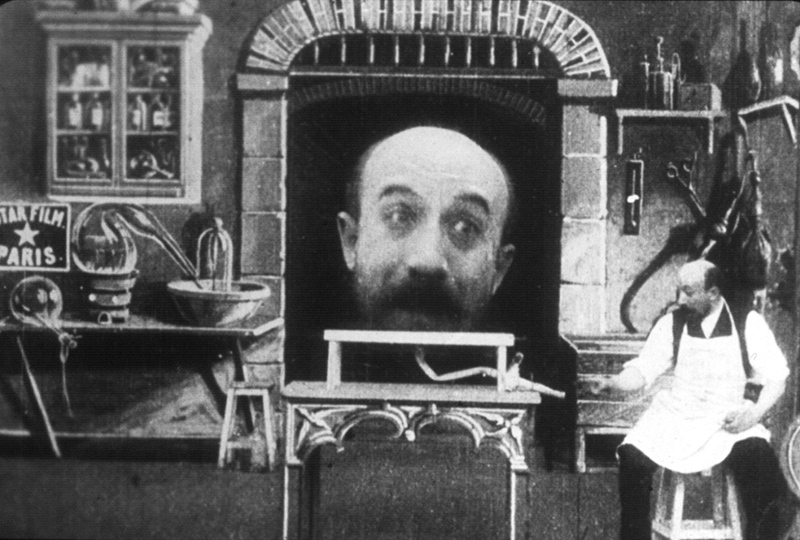
Whether it is seeing a T-Rex come to life in front of our eyes or seeing our billionth explosion on screen, special effects have a special place in film. It is one of many tools of the trade that allows a filmmaker to create an illusion to their liking. When done well, the audience is taken to a place not thought possible; done poorly and popcorn bombards the silver screen. Even if most effects are done digitally, the principle of having effects at all is key to creating a whole new world. One question may come to mind as you are reading this... Who is this old dude here?

(lauraretrolibrarian.blogspot.com)
This individual here is Georges Méliès. If anyone saw the film Hugo, you would recognize him as the man Ben Kingsley portrayed. This man was a great film innovator. He was one of the few to look at a film camera and see much more than a simple gimmick.

Stage Magician to Film Magician

Special effects in cinema are often considered magic tricks, so it is fitting that the father of special effects was a magician in real life. Although he originally was part of a family business in shoe making, Méliès hated making shoes. He sold his share of a shoe factory to his brothers and bought the Théâtre Robert-Houdin. Attendance was low at first, but Méliès was able to increase ticket sales by creating his own magic tricks.

When he first saw the film camera by the Lumière brothers, Méliès immediately tried to buy one from them. Although refused, he was actually able to build one himself. As soon as he got his hands on a camera, Méliès began to use effects such as the jump cut, the dissolve, and the double exposure.

Example of Double Exposure. (http://www.mexicanpictures.com)

Anytime you saw an object suddenly appear in a film, that is usually a jump cut. The story goes that while Méliès was filming a trolly, the camera jammed. He got the camera working again, but there was a hearse in the place of the trolly. When the film was developed, he noticed that the trolly turned into the hearse. This discovery led to one of the 1st instances of editing and was a common trick he used in his films.

Double Exposure... Or How to Clone Yourself

Today we have green screen and computers in order to duplicate an individual. However, Méliès was able to do so only with a film camera using double exposure. The reason it was called double exposure is because the same strip of film need to be exposed twice or more. First a subject is shot, with half of the lens covered; this allowed only part of the film to be exposed. Then the camera operator would have to rewind the film and cover the other part of the lens. When exposed and played back, it would look as though there are clones. In order to do the ghostly effects, the same process would be repeated without covering the lens.

(popmatters.com)

It is fun to think that without this one French man, we would not have the film The Avengers. While his tricks are not nearly as advanced as special effects are today, Méliès paved the way for many special effects to come.